
A portable generator without a dedicated generator transfer switch isn’t a complete power solution; it’s a significant safety liability that risks both your home’s circuitry and the lives of utility line workers. You’ve likely invested significant capital in a reliable power source, yet the technical divide between a 30A manual kit and a 200A automatic system often leads to unnecessary confusion. According to 2024 field reports, improper backup connections account for a measurable rise in utility backfeeding incidents, which can carry heavy local fines and cause catastrophic equipment failure.
We’ve built this guide to help you master the specific hardware requirements and safety protocols necessary for a professional grade installation. You’ll learn how to match amperage to your specific load requirements and ensure your setup meets the updated 2026 NEC standards for residential backup power. We’ll examine the critical differences between manual and automatic transitions to help you select the exact hardware that ensures a seamless power restoration during the next grid failure.
Key Takeaways
- Understand why a dedicated connection is the only legal method to bridge power and eliminate the catastrophic safety risks associated with backfeeding.
- Evaluate the technical trade-offs between manual and automatic interfaces to select the system that best matches your budget and preparedness strategy.
- Master the load calculations required to ensure your generator transfer switch amperage is correctly sized for your home’s critical appliances.
- Review mandatory professional installation standards and environmental ratings necessary to protect your equipment warranty and insurance validity.
- Discover how smart technology and solar integration are modernizing power management through real-time load monitoring and hybrid energy storage.
The Critical Role of a Generator Transfer Switch in Home Safety
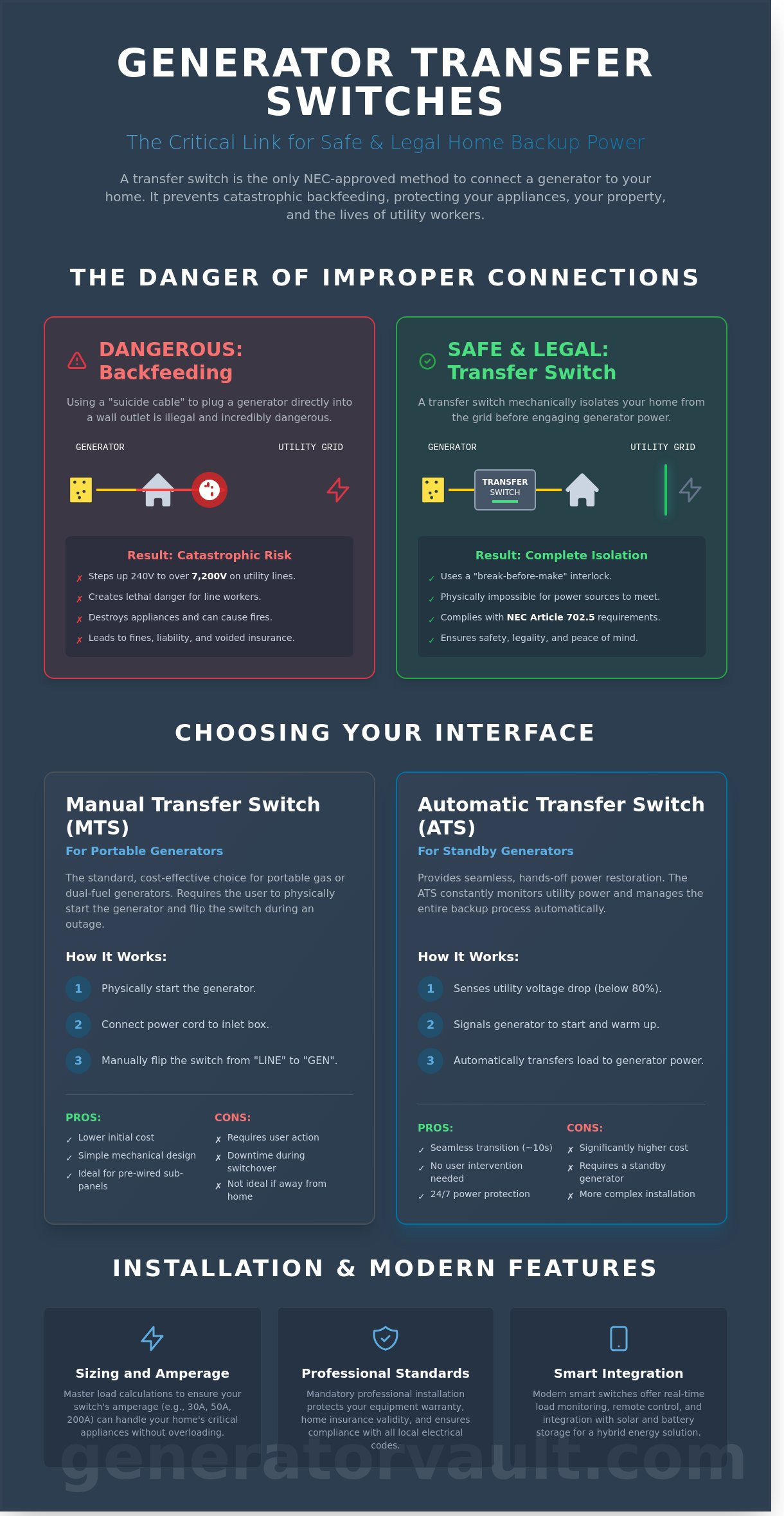
A generator transfer switch is the only safe and legal method to connect a portable or standby generator to your home’s electrical system. It acts as a permanent gateway that prevents your backup power from interacting with the municipal grid. Without this hardware, you risk damaging your home’s infrastructure or causing a fatal accident. National Electrical Code (NEC) Article 702.5 requires a transfer switch for any permanently installed optional standby system to ensure that the power sources remain separate. This device isn’t a luxury; it’s a fundamental safety component that protects your property and the utility infrastructure.
Backfeeding and Legal Liability
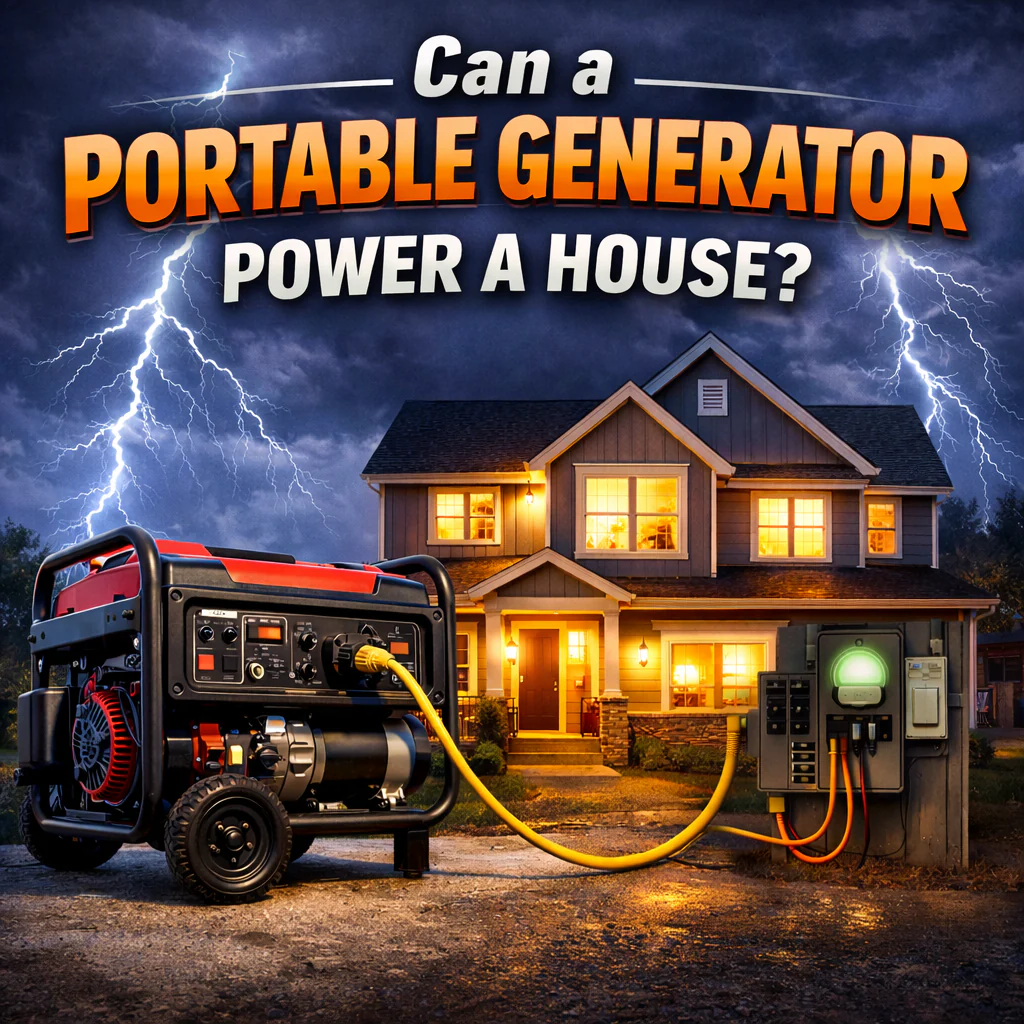
Backfeeding occurs when a generator is plugged directly into a wall outlet using a “suicide cable,” which features two male ends. This is a catastrophic safety violation. The electricity travels backward through your home’s electrical panel and into the utility transformer. This transformer, designed to step down voltage for home use, works in reverse to step up your generator’s 240V output to 7,200V or higher. Utility workers repairing lines during a blackout face electrocution from these energized wires.
The legal consequences are severe. Utility companies like Duke Energy or PG&E have strict policies to disconnect service immediately if they discover a non-compliant connection. Additionally, if an unapproved connection causes a fire, insurance providers typically deny claims based on the failure to adhere to NEC standards. Using a generator transfer switch protects your liability and the lives of line crews. It eliminates the risk of human error that leads to backfeeding by making it physically impossible to connect both power sources at once.
The Mechanism of Isolation
The core of every transfer switch is a “break-before-make” design. This mechanical interlock ensures the connection to the utility grid is broken before the generator circuit is established. This prevents the two power sources from meeting, which would instantly destroy your generator’s alternator and potentially cause an electrical fire. Manual switches require a physical toggle by the homeowner, while Automatic Transfer Switches (ATS) use internal sensors to detect a voltage drop below 80% of nominal levels. This automation provides a seamless transition.
Managing the neutral wire is another critical function of the switch. The setup depends on your specific hardware:
- Bonded Neutral Generators: These require a transfer switch that switches the neutral wire to prevent ground loops and nuisance tripping.
- Floating Neutral Generators: These usually connect to a standard transfer switch where the neutral is not switched, as the generator relies on the home’s existing grounding system.
Choosing the wrong configuration can lead to improper grounding, which leaves your sensitive electronics vulnerable to surges. A properly installed switch manages these technical nuances, ensuring your backup system operates as a closed, safe loop independent of the public grid.
Manual vs. Automatic Transfer Switches: Choosing Your Interface
Selecting a generator transfer switch dictates how you’ll interact with your backup power during a 2 a.m. outage. It’s the difference between a 10-minute walk through a dark garage and a 10-second seamless transition. While manual switches favor mechanical simplicity, automatic models prioritize hands-off continuity. The choice depends on your specific hardware and your tolerance for downtime.
Manual Transfer Switches (MTS)
MTS units are the standard choice for portable gas or dual-fuel generators. During a blackout, the user must physically start the generator, connect the heavy-duty power cord to the inlet box, and flip the switch to the “Generator” position. This mechanical toggle physically prevents your generator from backfeeding the utility grid, which protects line workers. For a 7,500-watt portable unit, a pre-wired sub-panel kit is the most efficient route. These kits come with 6 to 10 essential circuits already connected. This design saves up to 3 hours of installation labor compared to wiring individual circuit switches one by one.
Automatic Transfer Switches (ATS)
An ATS utilizes voltage sensing technology to monitor the utility line 24/7. When the voltage drops below a specific threshold, usually 70% to 80% of nominal power, the switch signals the generator to start. Integration is seamless with standby units like the Kohler 26kW or Briggs & Stratton PowerProtect series. These switches manage the entire process without human intervention. Beyond emergencies, the ATS facilitates a weekly exercise cycle. This 5 to 20-minute self-test ensures the engine remains lubricated and the battery stays charged.
Evaluating Reliability and Cost
Manual switches are nearly impossible to break because they rely on physical copper bus bars and heavy-duty levers. An MTS kit typically costs between $300 and $500, making it a budget-friendly option for occasional outages. Conversely, an ATS involves complex control boards and solenoids. While more sophisticated, they’re the only viable option for protecting sensitive medical equipment or high-value data servers. An ATS for a whole-home system can range from $800 to over $2,500 depending on the amperage rating, such as a 200-amp service entrance rated model.
If you’re still determining which capacity fits your home’s electrical panel, you can consult our sizing experts to find the right hardware. Reliability in a crisis depends on matching the switch to your generator’s peak output. A Briggs & Stratton 12kW standby unit requires a matching ATS to manage high-draw appliances like central air conditioners. Without this coordination, you risk stalling the engine or damaging the switch’s internal contacts. Choose based on your primary goal: rugged self-reliance or automated peace of mind.
Sizing and Amperage: Matching the Switch to Your Power Needs
Selecting the correct generator transfer switch requires a precise inventory of your electrical loads. You must identify your “must-run” circuits before purchasing hardware. For a typical 2,500 square foot home, these essentials usually include a well pump, which often requires a 240V double-pole breaker, the furnace blower or air conditioning unit, and refrigeration. If your generator produces 8,000 watts of continuous power, a 30-amp switch rated for 7,500 watts will fail under full load. The switch’s amperage rating must always meet or exceed the maximum continuous output of your power source to prevent terminal overheating and equipment damage.
For homeowners using portable units, the 30-amp versus 50-amp decision is the most common hurdle. A 30-amp system is standard for generators up to 7,500 watts. A 50-amp system is necessary for units reaching 12,500 watts. If you intend to power the entire home via a 200-amp service-entrance rated switch, the hardware must be installed between the utility meter and your main distribution panel. This setup allows the generator to energize every circuit in the house, provided the total load stays within the generator’s capacity.
The 30A vs. 50A Selection Guide
The choice between a 30A and 50A generator transfer switch dictates your plug and cable requirements. A 30A switch uses a NEMA L14-30 twist-lock connection and requires 10-gauge copper wire for runs up to 50 feet. A 50A switch utilizes a NEMA 14-50 plug, supporting up to 12,500 watts. This higher capacity requires 6-gauge wire to mitigate voltage drop. Using undersized cables for a 50A load causes a temperature spike that can melt insulation within 15 minutes of operation.
Load Management and Shedding
Smart transfer switches use load shedding to protect your generator from stalling. This technology monitors frequency and disconnects high-draw appliances like water heaters if the RPMs drop below a 58Hz threshold. When calculating your needs, account for Locked Rotor Amps (LRA). A standard 3-ton AC unit might pull 15 amps while running but requires an 80-amp LRA surge to start the compressor. Service-rated switches include a main disconnect, making them the primary shut-off for the entire building, whereas non-service models require an upstream breaker for protection.
Installation Requirements and Environmental Ratings
A licensed electrician must perform the installation of your generator transfer switch to ensure compliance with the National Electrical Code (NEC) Article 702. Attempting a DIY installation usually voids the manufacturer’s 5 year limited warranty and creates significant liability risks. Insurance providers often deny claims related to electrical fires if the equipment wasn’t certified by a professional. Beyond legalities, a professional ensures the system handles 240-volt loads without risking backfeeding, which can be fatal for utility line workers.
Manual configurations rely heavily on the Power Inlet Box (PIB). This component acts as the external gateway for your power supply. It’s a weather-proof housing mounted on the home’s exterior that allows you to plug the generator cord directly into the house wiring. This setup eliminates the need to run extension cords through open windows, which is a common carbon monoxide hazard during winter storms.
Indoor vs. Outdoor Enclosures
The mounting location dictates the required NEMA rating for the enclosure. NEMA 1 rated switches are built strictly for indoor use in dry areas like basements or attached garages. They protect against accidental contact but offer no defense against moisture. If you plan to mount the switch on an exterior wall, you must use a NEMA 3R enclosure. These are designed to shed rain and resist ice formation. For properties within 5 miles of the ocean, a NEMA 4X stainless steel enclosure is the standard for preventing salt-air corrosion, which can degrade copper contacts within 24 months in high-humidity zones.
The Installation Workflow
The installation begins by mounting the switch adjacent to the main service panel. The technician must interface the unit with the existing grounding system to prevent stray currents. It’s vital to verify that the device carries a UL 1008 listing. This specific safety standard ensures the switch can survive a massive short-circuit current without exploding. Recent data from 2024 indicates that 92% of equipment failures in residential backups are prevented by adhering to these rigorous testing standards.
Once the wiring is complete, the technician performs a “blackout test.” This involves disconnecting the utility main and verifying the load transfer under a 100% demand scenario. This step confirms that the voltage remains stable and doesn’t fluctuate outside the 5% tolerance required for sensitive electronics. If your system is ready for an upgrade, you can find professional-grade power solutions to complete your emergency setup.
- NEMA 1: Best for indoor, dust-free environments.
- NEMA 3R: Essential for outdoor weather resistance.
- UL 1008: The mandatory safety certification for transfer equipment.
- Grounding: Must be bonded according to local sub-panel codes.
Modern Innovations: Smart Switches and Solar Integration
The mechanical generator transfer switch has evolved into a sophisticated energy management hub. By 2026, the standard for home backup involves more than just a manual toggle; it requires digital logic to handle complex loads. Smart transfer switches now offer app-based monitoring that provides real-time data on every connected circuit. This level of transparency allows you to see exactly how much surge wattage your well pump requires compared to your HVAC system, removing the guesswork from emergency power management.
Smart Energy Management
Real-time wattage tracking is the best defense against generator overload. If your unit approaches 90% of its rated capacity, smart switches can execute automated load shedding. You can prioritize essential medical equipment while remotely deactivating high-draw appliances like electric clothes dryers from your smartphone. Integrating these switches into a smart home ecosystem allows for a coordinated disaster response, where the house automatically dims lights and adjusts thermostats the moment the utility grid fails.
Solar and Battery Hybrid Setups
The hybrid generator transfer switch acts as a traffic controller between three distinct power sources: the grid, the solar array, and the generator. This is particularly vital for homeowners using BougeRV solar kits or dedicated battery backups. In AC-coupled systems, the switch ensures your solar panels continue to charge your battery bank even when the grid is down. This creates a multi-layered redundancy system that maximizes fuel efficiency and extends generator runtime during prolonged outages.
Future-proofing also means preparing for Vehicle-to-Home (V2H) technology. As EV adoption increases, your car’s battery becomes a massive energy reservoir. Modern switches are being designed to handle bidirectional power flow, allowing an EV to power the home during peak pricing hours or extended blackouts. Generator Vault prioritizes high-durability switches for Kohler systems because these professional-grade components are rated for over 10,000 cycles, far exceeding the 3,000-cycle limit found in budget alternatives. Reliability is the only metric that matters when the lights go out.
Building a resilient system requires technical precision and an understanding of how these components interact over a ten-year lifespan. Consult our experts for a tailored power strategy to find the right hardware for your specific needs.
Securing Your Home Power Strategy for 2026
Installing a generator transfer switch is a non-negotiable step for any homeowner prioritizing safety and electrical code compliance. This hardware prevents the risk of backfeeding, which can damage your equipment and endanger utility workers during a grid failure. You must match the switch amperage to your home’s 100-amp or 200-amp service to maintain a stable power flow. Modern smart switches now offer 24,7 monitoring and solar integration, providing a level of control that was unavailable just a few years ago. Selecting the right interface ensures your critical appliances remain operational during the most severe weather events.
Generator Vault serves as an authorized dealer for Kohler and Briggs & Stratton, offering hardware built to withstand rigorous environmental demands. We provide free shipping on all orders over $50, and you can access flexible financing options for whole-home backup systems. Taking action now ensures your property is ready for the next outage. Browse our selection of Kohler and Briggs & Stratton compatible transfer switches to find the exact match for your power requirements. You’ve done the research; now it’s time to build a reliable foundation for your home’s energy independence.
Frequently Asked Questions
Can I install a generator transfer switch myself?
You can install a transfer switch yourself if you possess advanced electrical skills, but most local jurisdictions require a licensed electrician to pull permits. The 2023 National Electrical Code (NEC) Section 702 dictates strict wiring standards to prevent dangerous backfeeding into the utility grid. Improper DIY installation carries a 100% risk of voiding your home insurance or causing electrical fires. Hiring a pro ensures your 2026 safety inspections pass without issues.
What is the difference between a transfer switch and an interlock kit?
A transfer switch is a dedicated subpanel that isolates specific circuits, while an interlock kit is a mechanical slider that prevents the main breaker and generator breaker from being on at once. Transfer switches typically manage 6 to 12 critical loads like your furnace or well pump. Interlock kits allow you to toggle any breaker in your panel. Hardware for interlocks costs $50 to $150, while transfer switches range from $300 to $600.
Does a transfer switch work with a portable solar generator?
You can use a transfer switch with a portable solar generator if the unit provides a 120/240V AC output through a NEMA L14-30R or L14-50R port. Most solar units under 3,000 watts only offer 120V power, which requires a specific single-phase transfer switch. You’ll also need to verify if your solar station has a bonded neutral. If it’s bonded, you must use a 3-pole transfer switch to prevent ground-fault tripping in 2026 setups.
What happens if my generator is smaller than my transfer switch amperage?
Your system will operate safely if the generator is smaller than the switch’s rating, but you’re limited by the generator’s peak wattage. A 50-amp generator transfer switch can easily handle a 5,000-watt portable unit, though you won’t utilize the switch’s full 12,000-watt capacity. You must manually manage your loads to stay under the generator’s 20.8-amp limit. This configuration is actually beneficial because it allows for future generator upgrades without rewiring.
How much does it cost to have a transfer switch professionally installed?
Professional installation generally costs between $500 and $1,500 for parts and labor combined. Most electricians charge $75 to $150 per hour, and a standard project takes 3 to 5 hours to complete. If your electrical panel is older than 25 years or lacks physical space, expect to pay an extra $800 for a panel upgrade. These 2026 price estimates fluctuate based on your local permit fees and the distance to the inlet box.
Is a 30-amp or 50-amp transfer switch better for a whole-house backup?
A 50-amp transfer switch is the superior choice for whole-house backup because it supports up to 12,000 watts of continuous power. A 30-amp model caps your output at 7,200 watts, which often fails to start 3-ton central air conditioners or electric water heaters. Choosing the 50-amp generator transfer switch provides 66% more power capacity. This extra headroom is vital if you need to run high-draw appliances like a 4,500-watt dryer and a refrigerator simultaneously.
Do I need a special transfer switch for a generator with a GFCI outlet?
You need a neutral-switching, or 3-pole, transfer switch if your generator features a bonded neutral and GFCI-protected outlets. Standard transfer switches don’t switch the neutral wire, which causes the generator’s GFCI breaker to trip immediately when connected to the house. About 85% of portable generators built after 2022 use bonded neutrals to meet OSHA standards. Installing a specialized switch or a GFM kit prevents these nuisance trips during an emergency.
How do I know if my transfer switch is service-entrance rated?
You can identify a service-entrance rated switch by looking for a “Service Disconnect” label and a built-in main overcurrent breaker. These units meet UL 1008 standards and are designed to be the primary point of connection for your home’s utility power. If the switch sits between your utility meter and the main distribution panel, it must have this rating. Non-rated switches lack the internal bonding jumper and heavy-duty casing required by 2026 building codes.