
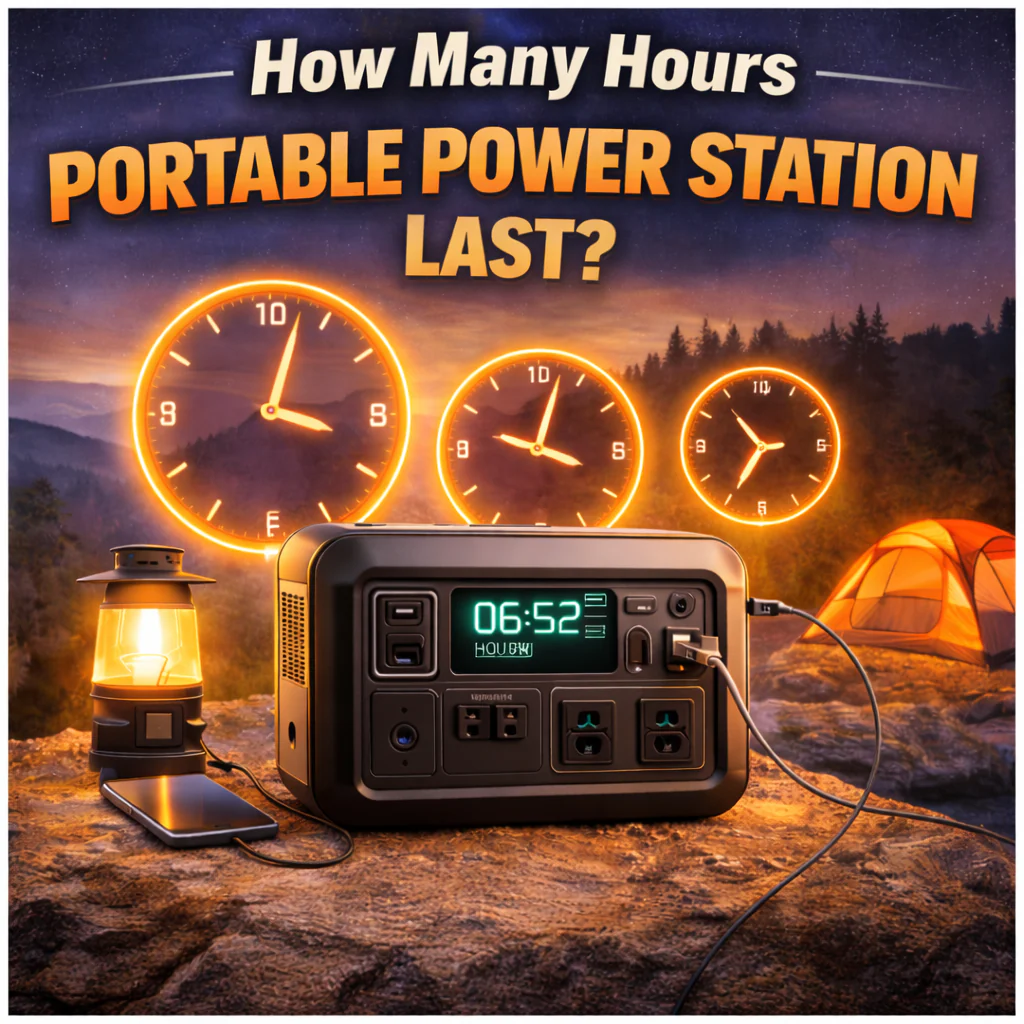
Whether you’re preparing for a power outage, planning a camping trip, or building a mobile office setup, one question matters more than any other: how many hours can a portable power station actually last?
The answer isn’t a single number. It depends on the station’s battery capacity, what you’re powering, and how efficiently the unit manages its energy output. A small portable power station might keep your phone charged for days but drain in under an hour running a space heater. Understanding the math behind runtime, and the factors that influence it, lets you choose the right unit and use it strategically.
What Determines How Long a Portable Power Station Lasts?
Three core factors control the runtime of any portable power station: battery capacity, power draw, and efficiency.
Battery Capacity (Watt-Hours)
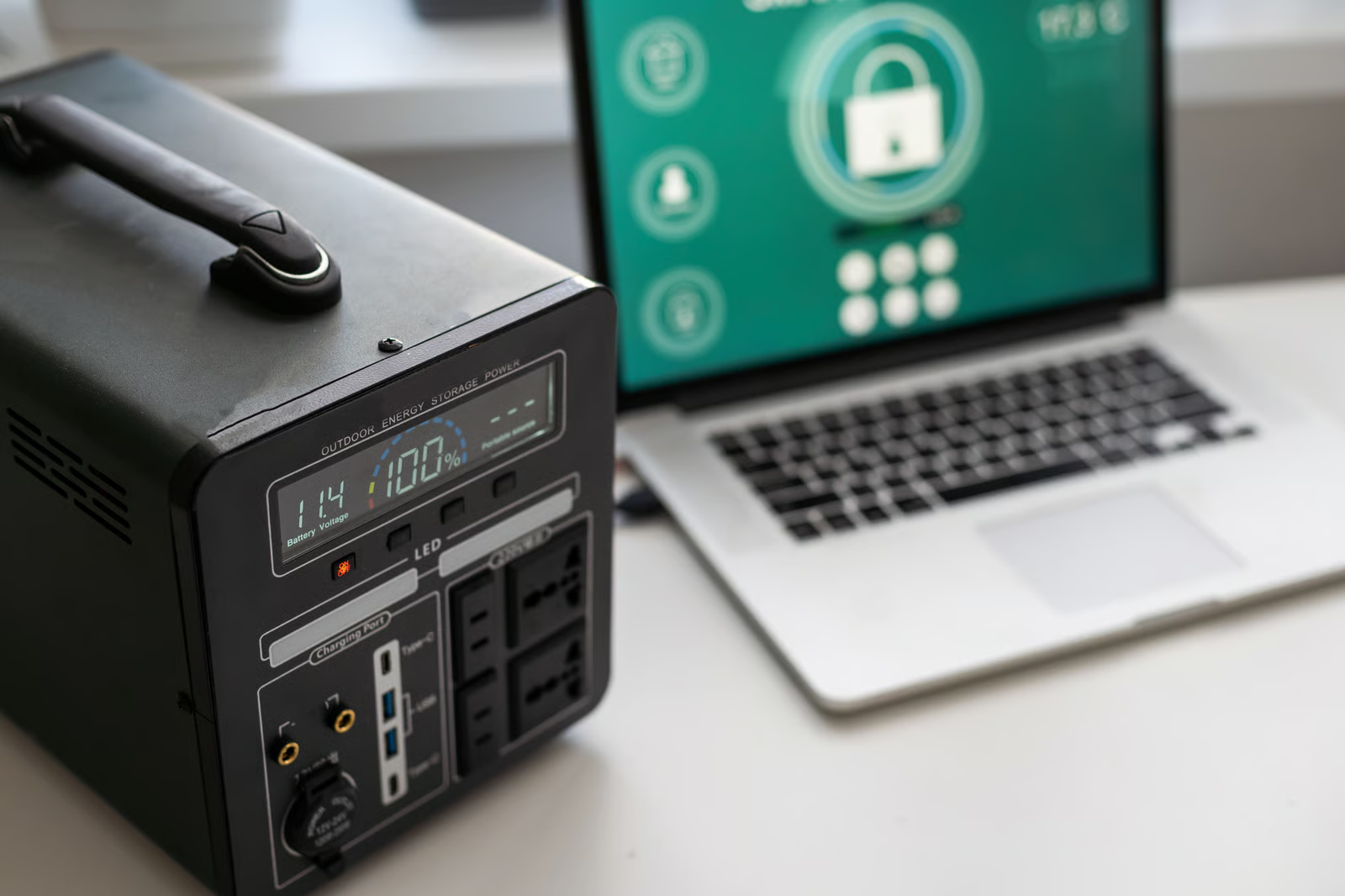
Every portable power station is rated in watt-hours (Wh), which tells you how much total energy the battery stores. Think of it like a fuel tank — the higher the watt-hour rating, the more energy you have before the tank hits empty.
Common sizes include small (200–500 Wh) for phones, laptops, and LED lights; mid-range (500–1,500 Wh) for mini fridges, CPAP machines, and TVs; and large (1,500–3,000+ Wh) for full-size refrigerators, power tools, and extended off-grid use.
Power Draw (Watts)
The devices you plug in determine how fast you drain the battery. Here’s a quick reference: smartphone chargers draw 5–20W, laptops 30–80W, mini fridges 50–80W running, microwaves 800–1,200W, and space heaters 750–1,500W. Low-draw devices sip energy slowly. High-draw appliances gulp it down.
Inverter Efficiency
No portable power station delivers 100% of its stored energy. The internal inverter loses some energy as heat during DC-to-AC conversion. Most quality units operate at 85–90% efficiency, meaning a 1,000 Wh battery realistically delivers around 850–900 Wh of usable power. Always factor this in.
How to Calculate Runtime
The formula is straightforward:
Runtime (hours) = Battery Capacity (Wh) × Inverter Efficiency ÷ Device Wattage (W)
Using a 1,000 Wh portable power station at 85% efficiency (850 usable Wh):
- Smartphone charger (15W): ~56 hours
- Laptop (50W): 17 hours
- CPAP machine (40W): ~21 hours
- Mini fridge (60W avg): ~14 hours
- 32-inch TV (45W): ~19 hours
- Microwave (1,000W): ~51 minutes
- Space heater (1,500W): ~34 minutes
When running multiple devices simultaneously, add up total wattage and use that combined number. A laptop (50W) + LED light (15W) + phone charger (15W) = 80W total, giving roughly 10.5 hours from a 1,000 Wh unit.
How Solar Power Stations Change the Runtime Equation
Here’s where things get interesting. A standard portable power station has a fixed amount of energy, once drained, you need an outlet or time to recharge. But solar power stations eliminate that ceiling entirely.
Solar power stations are portable power stations paired with solar panels, creating a renewable charging loop that extends runtime indefinitely, as long as the sun cooperates. Instead of watching your battery drop to zero, you’re actively replenishing it throughout the day.
For example, a 1,000 Wh portable power station connected to 200 watts of solar panels getting roughly 5 peak sun hours generates approximately 1,000 Wh daily, enough to fully recharge every day. If daily consumption stays at or below that, you’ve created a self-sustaining system with theoretically unlimited runtime.
This is why solar power stations have exploded in popularity among overlanders, RV owners, off-grid cabin dwellers, and emergency preparedness planners. They transform a finite battery into a renewable energy system you can depend on for weeks or months.
When shopping, pay attention to maximum solar input ratings. A station accepting 400W of solar input recharges far faster than one capped at 100W.
Factors That Reduce Real-World Runtime
Several real-world factors shorten actual runtime beyond what the math predicts.
Temperature matters. Lithium-ion and LiFePO4 batteries lose capacity in extreme cold — expect 10–20% reduction in freezing temperatures. Extreme heat accelerates long-term degradation.
Battery age and charge cycles. Standard lithium-ion retains about 80% capacity after 500 cycles. LiFePO4 batteries maintain 80% after 2,500–3,500 cycles — a major advantage for daily use.
Starting watts vs. running watts. Appliances with compressors or motors draw a surge two to three times higher than running watts when kicking on. If the surge exceeds your station’s peak output, the unit shuts down.
Simultaneous load management. Running five devices at once drains faster than running them sequentially. Stagger high-draw devices to maximize total runtime.
Choosing the Right Size Portable Power Station
Day trips (200–500 Wh): Phones, tablets, cameras, laptop. Fits in a backpack.
Weekend camping (500–1,000 Wh): Add a mini fridge, TV, or CPAP. Full weekend without recharging, or indefinite with a solar panel.
Extended off-grid or home backup (1,500–3,000+ Wh): Full-size fridge, lights, communication devices, medical equipment. Pair with high-wattage solar panels for long-term reliability.
Whole-home backup (3,000+ Wh or expandable): Expandable systems with additional battery modules push capacity to 10,000–25,000+ Wh, bridging the gap to whole-home standby generators.
The Bottom Line
How many hours can a portable power station last? Anywhere from 30 minutes to several days, it all comes down to battery capacity, what you’re powering, and whether you’re recharging with solar.
For most people, a mid-range portable power station in the 500–1,500 Wh range covers everyday needs. Pair it with solar panels and you’ve built a solar power station setup that keeps energy flowing as long as you need it, no fuel, no fumes, no noise.
Work backward from your actual power needs. Calculate your device wattage, apply the runtime formula, and pick a unit with enough headroom to keep you comfortable when it counts.