
A lot of RV solar plans look great on paper until you spend one cloudy afternoon watching your battery percentage drop faster than expected. That is why a real rv solar setup example is more useful than a generic parts list. If you know how much power you use, how long you stay off-grid, and what you actually want to run, you can build a system that works without overspending.
This guide walks through one practical setup for a common travel style: weekend to multi-day boondocking with normal comfort loads, light kitchen use, device charging, and occasional TV time. It is not built for running a rooftop air conditioner all day, because that changes the budget and system size fast.
A realistic RV solar setup example
Let’s use a mid-size travel trailer or fifth wheel as the model. The goal is to support lights, water pump, vent fans, phone and laptop charging, a 12V fridge or efficient RV fridge controls, a TV for a short period, and small kitchen appliances in limited bursts.
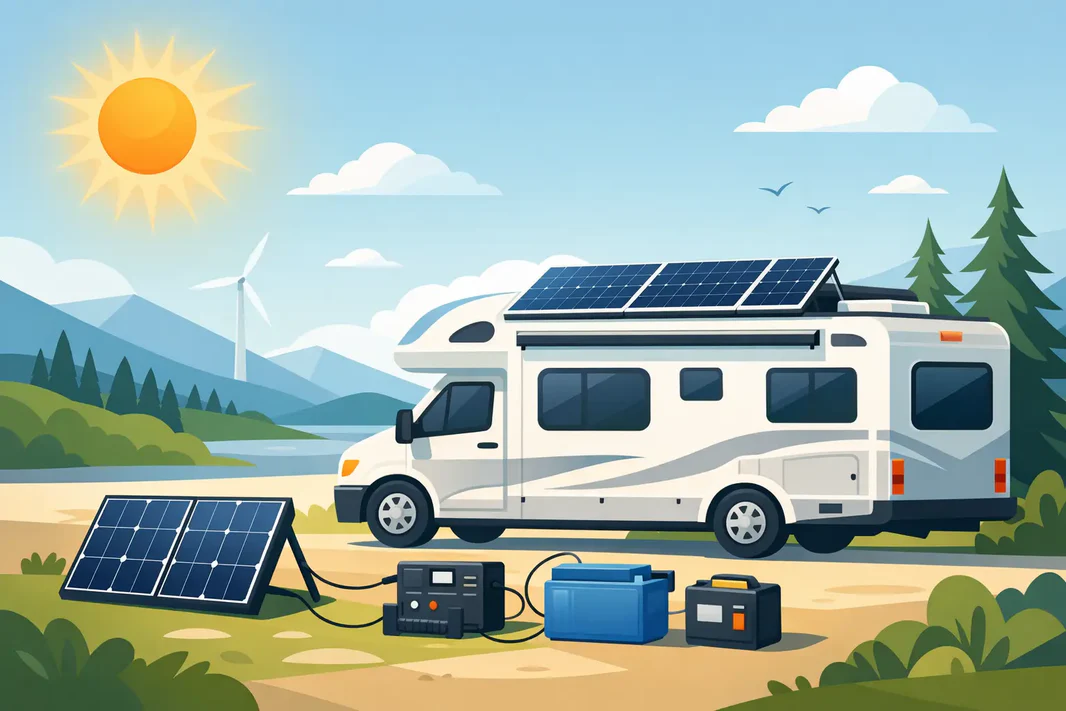
A solid example system would look like this:
- 600 watts of solar panels
- 200Ah of LiFePO4 battery storage at 12V
- 2000W pure sine wave inverter
- 50A MPPT charge controller
- Proper fusing, disconnects, and appropriately sized cables
This is a practical middle ground. It gives enough production and battery storage for real off-grid use, but it is still manageable in cost, roof space, and installation complexity.
Why this setup works for many RV owners
The biggest mistake in RV solar planning is sizing the system around wishful thinking. People either assume solar will run everything, or they build so small that they are still babysitting battery levels every evening.
With 600 watts of solar, you may collect roughly 1.8 to 2.7 kWh per day in less-than-perfect conditions, and more in strong sun. In excellent summer conditions, you might do better. In winter, heavy shade, or poor panel angle, you may do worse. That range matters because RV charging is never as simple as multiplying panel wattage by peak sun and calling it done.
A 12V 200Ah lithium battery bank gives about 2.56 kWh of total storage. Since lithium batteries can usually be discharged much deeper than lead-acid without major penalty, you get a lot more usable power from a smaller footprint. For most RV shoppers comparing options, this is one of the clearest value upgrades available.
The 2000W inverter is there for flexibility. It can handle many everyday AC loads like a coffee maker, microwave in short bursts, laptop chargers, and entertainment gear. It will not magically make your battery bigger, though. High-watt appliances still drain storage quickly, so inverter size should match realistic use, not just peak ambition.
The daily power budget behind this rv solar setup example
To see whether a setup is enough, look at actual energy use. Here is a realistic daily estimate for a moderate-use RV:
LED lighting might use 100 to 150Wh per day. A water pump may only use 50Wh. Vent fans could take 150 to 300Wh depending on weather. A TV for a couple hours might add 100 to 150Wh. Phones, tablets, and laptops can easily use another 150 to 300Wh. If you use a coffee maker or microwave briefly, that may add 150 to 250Wh.
Then there is refrigeration. A 12V compressor fridge can use anywhere from about 400Wh to over 800Wh per day depending on size, ambient temperature, and cycling. That single load can change the system recommendation more than anything else besides air conditioning.
So a moderate daily total might land around 1.2 to 2.0 kWh. That fits reasonably well with a 600W solar array and 200Ah lithium battery bank, especially if you travel in sunny regions and manage heavy loads carefully.
What this system can run well
This setup is a good fit for RV owners who want quiet power, less generator runtime, and more freedom to camp without hookups. It can comfortably support normal 12V loads and moderate inverter use. It also gives a nice buffer for cloudy weather compared to smaller entry-level systems.
It is especially strong for travelers who work remotely part time, families charging multiple devices, and campers who want convenience without committing to a large and expensive roof build.
Where it starts to struggle is sustained high-draw equipment. A hair dryer, electric skillet, space heater, and air conditioner can all pull significant wattage. The system can run some of those loads briefly, but not all of them regularly without draining the battery fast.
Where this setup may fall short
This is the part many articles skip. Solar is not one-size-fits-all.
If your RV has a residential refrigerator, frequent microwave use, Starlink running all day, or long stays in tree cover, this example may feel undersized. The same is true if you camp in hot climates and expect battery power to carry air conditioning for hours. That usually requires a much larger battery bank, more panel wattage, and often a different class of inverter and charging strategy.
On the other hand, if your use is light and you mostly need lights, pump, charging, and a fan, this exact setup might be more than enough. In that case, a 400W array with 100Ah to 200Ah of lithium could make more financial sense.
Choosing components without creating bottlenecks
A solar system is only as good as its weakest link. Oversizing one part while undersizing another usually leads to frustration.
For example, 600 watts of solar paired with a PWM controller leaves charging performance on the table. A quality MPPT controller helps capture more usable energy, especially in varied temperatures and partial shade conditions. It is one of those upgrades that tends to pay off in real-world performance rather than just spec-sheet appeal.
Battery chemistry matters too. Lead-acid batteries still have a place for lower upfront cost, but they are heavier, less efficient, and offer less usable capacity. For RV owners who care about space, weight, and dependable overnight power, lithium is usually the cleaner long-term solution.
Then there is inverter sizing. Bigger is not always better. A large inverter has its own idle draw and cost penalty. If you only plan to run small electronics and occasional kitchen loads, 2000W is usually a smart ceiling for a mid-size RV setup. If your loads are lighter, 1000W to 1500W may be enough.
Installation details that matter more than shoppers expect
Panel wattage gets most of the attention, but cable sizing, fuse protection, and roof layout matter just as much. Voltage drop can quietly reduce system efficiency. Poor routing can create maintenance headaches. Inadequate fuse protection is not just an inconvenience – it is a safety issue.
Roof space also affects the design. Six hundred watts may be easy on one RV and difficult on another depending on AC shrouds, vents, skylights, and antenna placement. Flexible panels may look convenient, but rigid panels often offer better longevity and thermal performance. It depends on roof shape, mounting goals, and weight limits.
If you are not comfortable with DC wiring, this is one area where professional installation can make sense. A good install is about more than getting power. It is about safe charging, long-term reliability, and making troubleshooting easier later.
When to size up from this example
If you read this rv solar setup example and think it sounds close but slightly small, that is probably your answer. Most RV power regrets come from underbuilding.
Moving to 800 watts of solar and 300Ah to 400Ah of lithium gives more breathing room for cloudy days and heavier loads. That upgrade is common for full-timers, remote workers, and families with larger daily demand. It also reduces how often you need to rely on shore power or a generator backup.
That said, not everyone needs to chase the biggest system possible. More battery and panel capacity means more cost, more weight, and often more installation complexity. The best setup is the one that reliably covers your actual use pattern.
Shopping with the right goal in mind
If you are comparing solar panels, batteries, inverters, or complete kits, start with the loads you want to support first. Then match components around that reality. Buying parts because they are popular often leads to mismatched systems and wasted budget.
For buyers who want a simpler path, GenVault offers solar-ready power products, batteries, inverters, panels, and backup power options built around practical use cases rather than guesswork. That matters when you are trying to build a system that works at a campsite, not just in a spreadsheet.
A good RV solar setup should make travel easier. If your system supports your habits without forcing constant compromises, you sized it right.